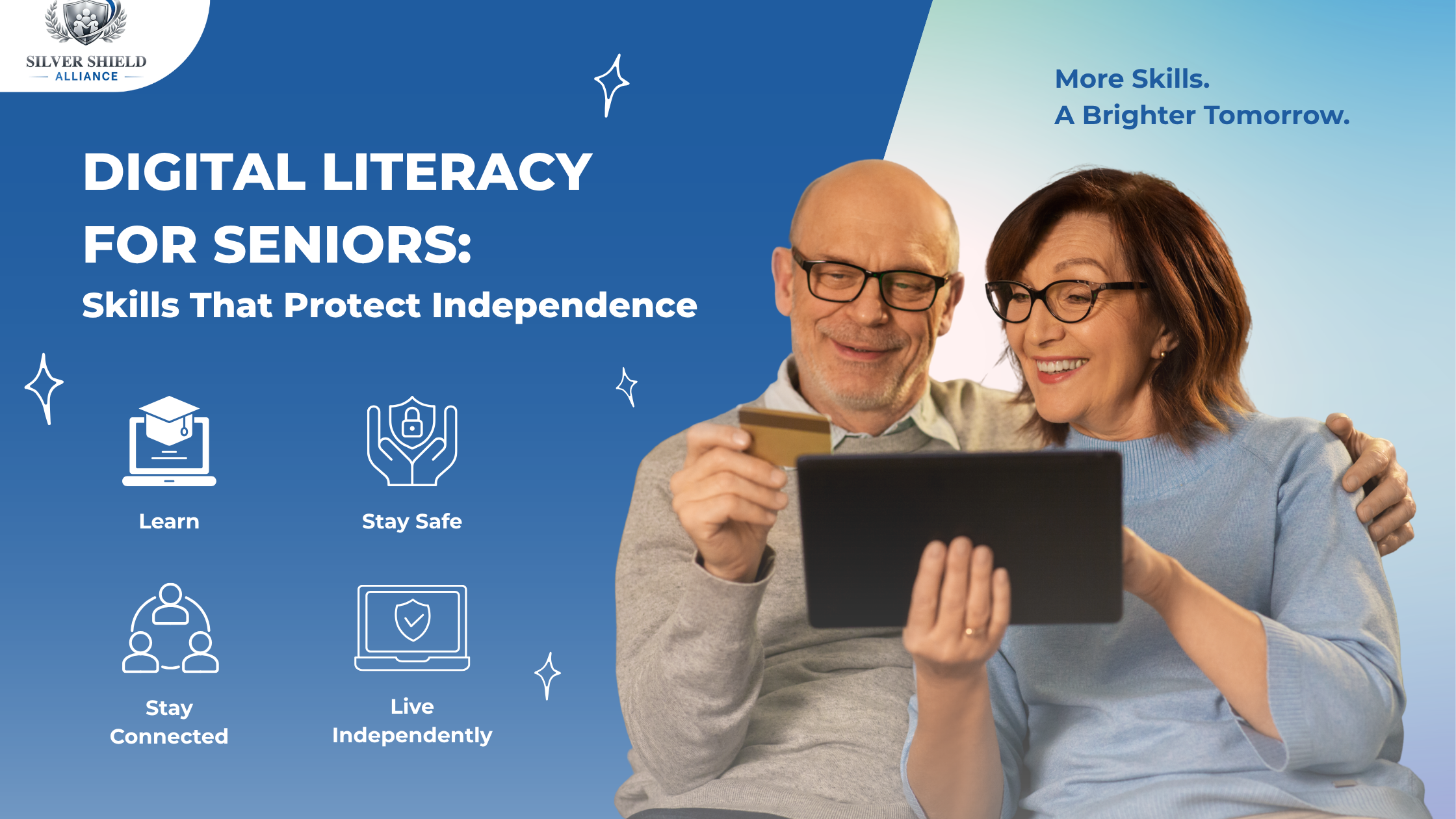
What happens when doing something for yourself requires a password, an app or a verification code?
That question gets to the real meaning of digital literacy for seniors.
Today, independence can include scheduling a medical appointment, checking a bank balance, joining a video call, finding directions, reviewing a bill or deciding whether information online can be trusted.
The goal is not to turn every older adult into a technology expert.
The goal is to make technology less likely to become a reason someone has to surrender a task they could otherwise manage themselves.
Digital Literacy Is Becoming an Independence Skill
Technology adoption among older adults is already high. AARP's 2026 technology research found that smartphone ownership among adults 50+ reached 90% in 2025. Yet access does not automatically create confidence. About 30% of adults 50+ say they do not have the digital skills needed to take full advantage of being online.
That distinction matters.
Owning a smartphone is access.
Knowing what to do when your bank app asks for verification, your doctor's office sends a portal message, or an AI search produces an uncertain answer is digital confidence.
Six Senior Digital Skills That Protect Everyday Independence
1. Managing money digitally
Useful senior digital skills include checking transactions, recognizing legitimate payment requests, using banking apps and knowing when to stop before authorizing a transfer.
Digital literacy should help someone manage money with greater understanding, not greater anxiety.
2. Navigating healthcare
Patient portals, telehealth visits, prescription apps and appointment systems are now part of modern healthcare.
AARP research published in 2026 found that confidence among adults 50+ was high for finding health information online but lower for more complex activities such as telehealth.
Good technology education for seniors should therefore teach the whole process, not simply which button to press.
3. Communicating with confidence
Texting, video calls, messaging apps and social platforms can help people stay involved with family, friends and communities.
The important skill is understanding privacy settings, contacts, links, attachments and how different communication tools work.
4. Judging information before acting
Digital literacy also means knowing how to ask:
Who created this? Why am I seeing it? Can I confirm it somewhere else?
Those questions are useful for news, health claims, financial information, advertisements and unfamiliar messages.
5. Understanding AI without needing to become an expert
AI is quickly becoming part of search, smartphones, customer service and everyday apps.
AARP reports that generative AI use among adults 50+ increased from 18% in 2024 to 30% in 2025.
The important skill is not memorizing every AI tool. It is understanding what AI can help with, what information should remain private and when an answer needs independent verification.
6. Knowing how to recover from a mistake
One of the most overlooked digital skills is recovery.
People should know how to reset a password, review account activity, change permissions, contact a legitimate organization and ask for help.
Confidence grows when a mistake does not feel irreversible.
Digital Inclusion Means More Than Providing Access
For families, libraries, senior communities, healthcare providers and other organizations, digital inclusion for older adults cannot end with Wi-Fi access or a device.
People also need opportunities to practice.
Silver Shield Alliance approaches technology education for seniors through real-life situations rather than expecting people to learn every feature of every device.
Its AI & Technology Training helps older adults build practical skills around smartphones, apps, communication and AI, while its digital safety workshops create space to practice decisions and ask questions without pressure.
The measure of good digital literacy is not how many apps someone knows.
It is simpler: Can technology help someone keep doing more of life on their own terms?
That is the skill worth building